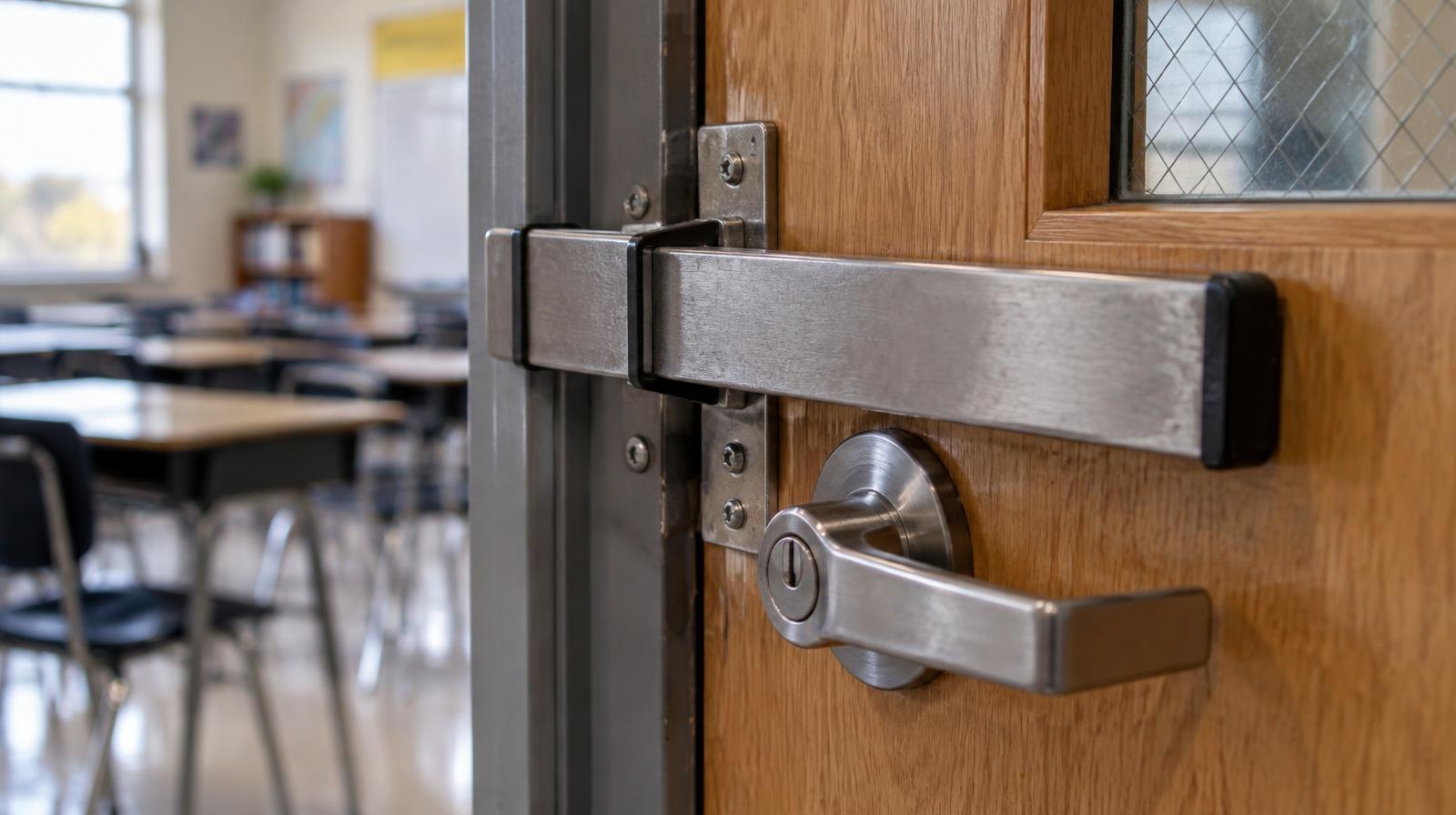
The Florida State Board of Education voted unanimously Wednesday, Oct. 14, to require school districts using temporary secondary classroom locks to provide master keys or access credentials to first-responder agencies.
The revised rules, reported by the Tampa Bay Times, also establish requirements for secondary locks installed after Jan. 1, 2027. Those devices cannot have permanent floor attachments, must be unlockable from outside the classroom with a key and must be easily disengaged from inside.
The changes apply statewide to public schools and charter schools that choose to use temporary secondary locks during active-assailant emergencies. Schools are not required to install the devices.
Any Pinellas County campus that installs the locks, including Palm Harbor University High School or Dunedin High School, would have to comply with the applicable requirements.
State responds to concerns over emergency access
Tim Hay, director of the state's Office of Safe Schools, told board members the revisions were developed in response to public feedback.
Asked whether the requirements would impose additional costs on school districts, Hay said there should be no mandatory expense because installing secondary locks remains voluntary.
"It's an optional thing that school districts can choose to do," Hay said, according to the Tampa Bay Times.
A 2025 Florida law authorized classrooms equipped with permanent door locks to use temporary secondary locks during school shootings and other active-assailant incidents.
Under Florida Statute 1006.07, the devices must be removable from inside the classroom in a single operation without a key. They must also be accessible from outside using a key or other credential, comply with fire safety requirements and be incorporated into schools' active-assailant response plans.
The State Board of Education initially adopted rules to implement the law, but those requirements drew objections from lock manufacturer Nightlock.
Lock manufacturer challenges state's authority
Nightlock, which manufactures temporary classroom barricade devices, argued that the state Department of Education had exceeded its authority by imposing restrictions beyond those authorized by the Legislature.
The company filed an administrative challenge, and a virtual hearing was scheduled for Aug. 21, according to WUSF.
More than 250 Florida schools, most of them private, use Nightlock devices, according to company co-owner Jack Taylor.
The latest revisions did not resolve the company's objections.
Benjamin Grossman, an attorney representing Nightlock, told board members the revised rule "unquestionably is not legal" because he believed it continued to exceed the authority granted by state law.
Grossman said he had submitted proposed changes before the meeting but that his recommendations were not incorporated.
Board members did not comment on his objections before voting unanimously to approve the revisions.
The outcome of Nightlock's administrative challenge has not been independently confirmed.
Schools face key inventory and training requirements
Beyond providing emergency access credentials to first responders, districts must conduct annual inventories of issued keys and credentials, according to CBS 12.
Schools must also obtain fire-code compliance approval from the appropriate fire officials and submit documentation to the Florida Department of Education before students occupy classrooms equipped with the devices.
School personnel and first responders must receive training on operating the locks from both sides of classroom doors.
The revisions remove a previous requirement for that training to take place every semester.
The updated regulations are intended to ensure that classroom barricade devices can help secure rooms during emergencies without preventing firefighters, law enforcement officers or other emergency personnel from entering.
Pinellas schools could be affected by statewide changes
The requirements would apply to Pinellas County Schools campuses that use or choose to install temporary secondary classroom locks.
The district has not publicly confirmed whether Palm Harbor University High School, Dunedin High School or other campuses currently use the devices or plan to install them.
Sean Jowell, the district's director of safety and security, discussed artificial intelligence-based weapons detection systems during an October 2025 School Board workshop, but that discussion did not establish whether the district uses temporary classroom barricade locks.
The state has not required districts to purchase or install the devices, and no districtwide installation cost has been announced for Pinellas County Schools.
The changes are part of Florida's broader school safety requirements governing classroom security and emergency response.



.jpg)