Palm Harbor and Dunedin homeowners are seeing a puzzling result on their 2026 TRIM notices: home values fell, but proposed tax bills rose.
The Pinellas County Property Appraiser's office says that contradiction is the most common question staffers are fielding, according to the St. Pete Catalyst. The culprit is a Florida assessment rule known as "recapture." Truth in Millage (TRIM) notices went out to property owners across Pinellas County in late August.
Assessment caps explain how bills can rise as values fall
Florida property taxes hinge on three numbers. Just/Market Value is what the Property Appraiser says a home was worth as of Jan. 1, 2026. Assessed Value is a separate, capped figure used for tax calculations. Taxable Value is the assessed value minus exemptions like homestead.
The caps are the key. Under Save Our Homes, a homesteaded property's assessed value can rise no more than 3% per year or the change in the Consumer Price Index, whichever is lower. Non-homestead properties face a 10% annual cap.
When home prices soar for years, those caps hold assessed values well below market value. A gap builds. When the market reverses, the capped assessed value can keep climbing toward the still-higher market value even as that market value falls.
That is recapture.
One Pinellas property shows the gap in real numbers
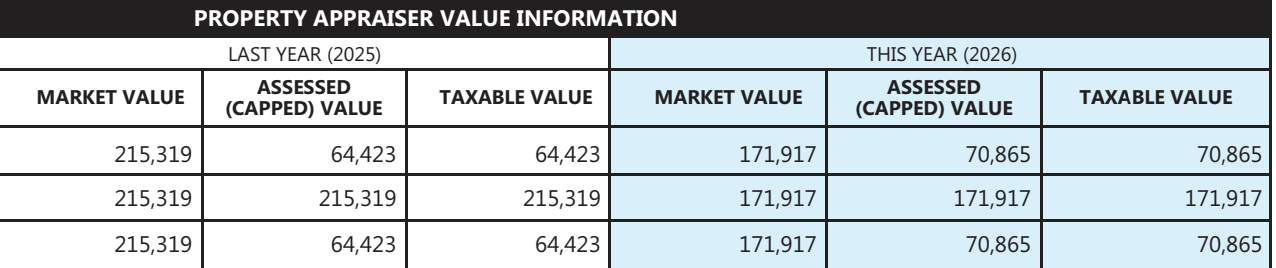
One non-homestead property's TRIM notice tells the story. Its market value dropped from $215,319 in 2025 to $171,917 in 2026, a loss of more than 20%. Its assessed value for city and county taxes moved the opposite direction, rising from $64,423 to $70,865, a nearly 10% increase.
The assessed value had been held far below market value by the 10% cap. Even after the market price fell, the capped figure was still catching up.
Not every property faces this. A home whose assessed value already sits close to its market value could see both numbers fall together.
County lost $5.5 billion in market value, appraiser says
Pinellas County Property Appraiser Mike Twitty put the scale of the correction in stark terms at a public information session in late August.
"Pinellas lost $5.5 billion in overall aggregate market value," Twitty said, adding that "the worm has turned there."
Twitty, who has served as property appraiser since 2016, held a TRIM education session for first-time Florida homeowners on Aug. 27 at the appraiser's office in St. Petersburg, according to the Tampa Bay Beacons. The same assessment-cap mechanics behind recapture also surprise new buyers. In a March 2026 op-ed on the appraiser's website, Twitty described homeowners who relied on online listings showing a seller's taxes, only to discover their own bill was far higher. He cited a Dunedin townhouse listed at $699,900 where the seller paid $2,904 a year in taxes but a buyer's estimated bill was $10,471.
Petition deadline and what to check before bills arrive
The TRIM notice is not a bill. Actual property tax bills arrive in November 2026. The notice shows proposed values and the tax rates local authorities plan to adopt. It also lists the dates and times each taxing authority will hold public hearings on those rates.
The millage rate, calculated as $1 for every $1,000 of taxable value, also determines the final bill. Homeowners should review both their assessed value and the proposed millage rates on the notice.
Homeowners who believe their property is overvalued can file a petition with the Value Adjustment Board (VAB). The deadline to file a VAB petition in Pinellas County is Friday.





.jpg)