Pinellas County emergency managers are urging Palm Harbor and Dunedin residents to stay hurricane-ready even as forecasters predict the quietest Atlantic season in more than a decade.
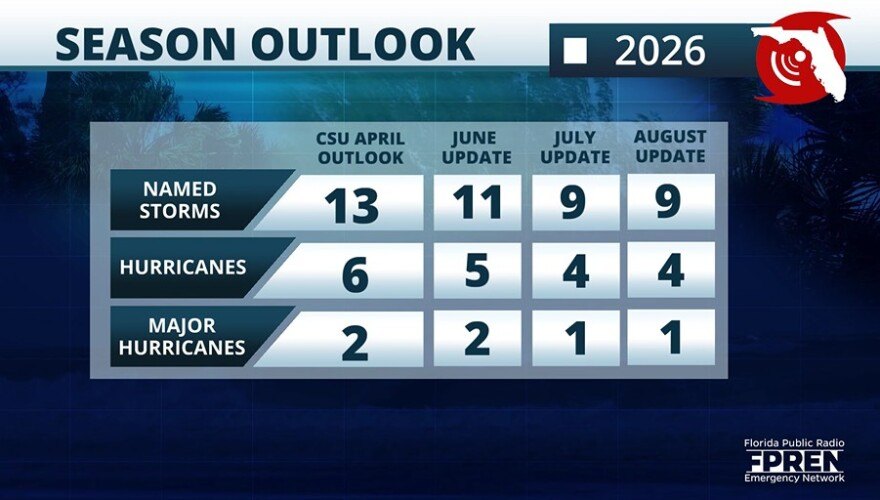
Colorado State University held its forecast steady on Wednesday, Aug. 5, calling for just nine named storms, four hurricanes and one major hurricane through Nov. 30. An average season produces 14 named storms, seven hurricanes and three major hurricanes.
If the forecast holds, it would be the second-lowest August outlook CSU has issued since it began publishing seasonal predictions in 1984.
"That's not to say we won't see anything," Phil Klotzbach, lead author of CSU's seasonal hurricane forecast, told the Herald Tribune. "I want to be careful because a lot of people have written off the season, but you have to keep your eyes to the sky and pay attention to things, especially in the subtropics."
Why so quiet
A strengthening El Niño is driving the suppressed activity. The climate pattern promotes drier air and stronger upper-level wind shear across the Atlantic, both hostile to tropical cyclone development. CSU said in its forecast update it is "extremely confident" a strong El Niño will persist through peak season.
The numbers bear that out. Through early August, the Atlantic had generated just 2.6 units of accumulated cyclone energy, more than 70 percent below the long-term average. Only two named storms have formed so far: Tropical Storm Arthur, which lasted less than a day, and Tropical Storm Bertha, which struggled to organize despite warm Gulf waters.
CSU expects total 2026 activity to reach roughly 40 percent of an average season. The probability of a major hurricane striking the U.S. East Coast including the Florida Peninsula sits at 7 percent, compared to a historical average of 21 percent.
One storm is all it takes
Quiet seasons have produced deadly storms before. In 2015, the last time CSU forecast such low activity, Hurricane Joaquin still grew into a Category 4 storm and sank the cargo ship El Faro near the Bahamas, killing 33 people.
Pinellas County Emergency Management ran a five-day countywide hurricane exercise July 5–9, simulating a Category 3 storm making landfall with 120-mph winds and 10 to 15 feet of storm surge. About 400 representatives from local, state and federal agencies participated at the county's Emergency Operations Center in Largo.
"Exercises like this allow us to strengthen that coordination and fine-tune our emergency procedures so we can be prepared," Emergency Management Director Cathie Perkins said during the county's July 5–9 hurricane exercise.
What Palm Harbor and Dunedin residents should do now
More than 85 percent of Atlantic tropical cyclones develop from August through October, with activity typically cresting around Sept. 10. NOAA's long-term tropical outlook showed no expected Atlantic activity through Aug. 26 as of Wednesday, but conditions can change fast.
Residents can look up their evacuation zone and sign up for Alert Pinellas emergency notifications at disaster.pinellas.gov. The county's disaster preparedness guide is available at pinellas.gov/hurricane-guide, and the Ready Pinellas app provides real-time alerts. The non-emergency information line is 727-464-4333.



.jpg)