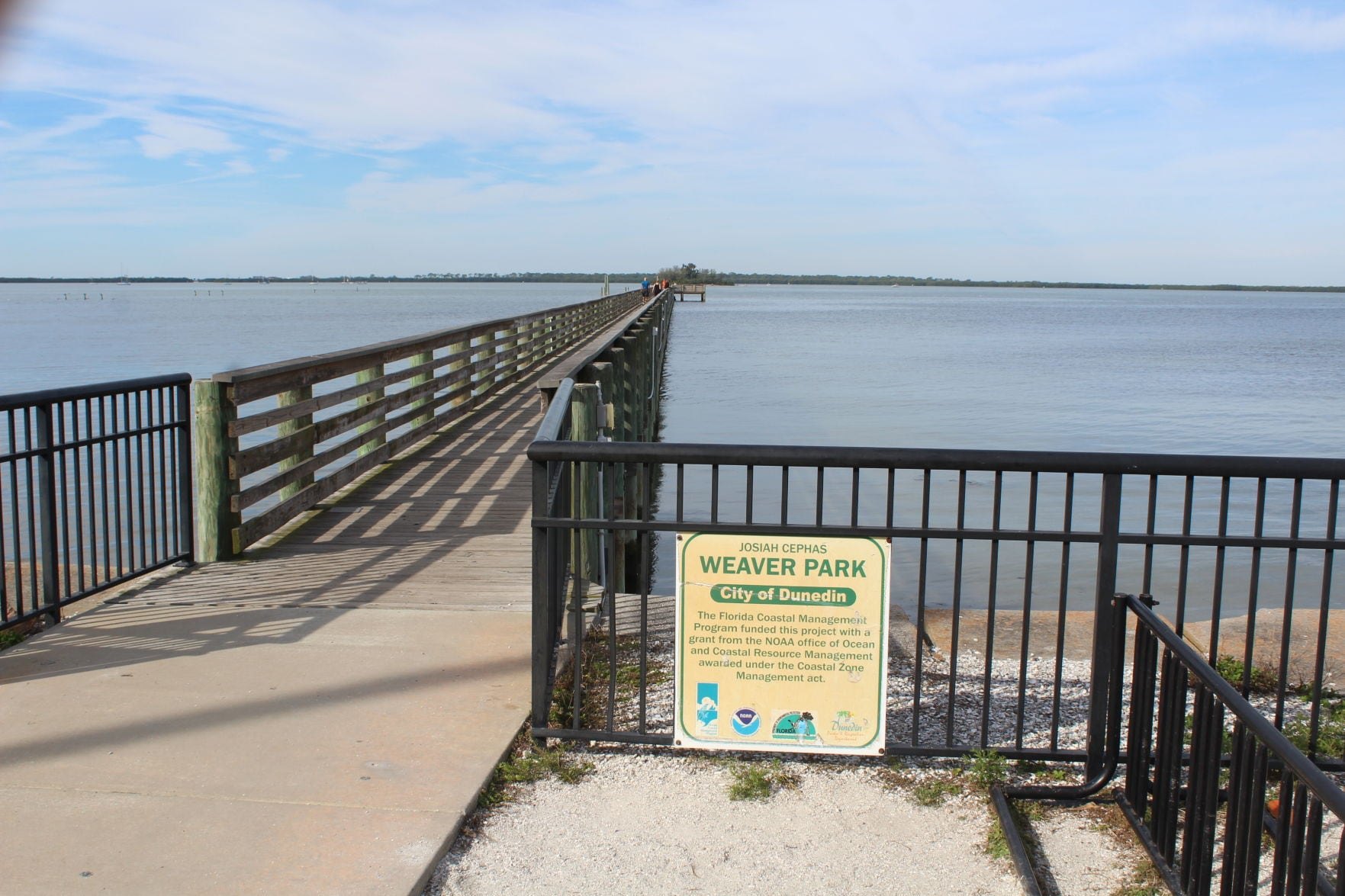
Dunedin's crumbling seawall at Weaver Park will be replaced by mangroves, oyster beds and native plants instead of concrete and rock — if the city can afford it after a statewide property tax vote in November.
City commissioners unanimously approved the $2.5 million living shoreline project at a work session Tuesday, choosing a nature-based fix for 728 linear feet of failing seawall. But City Manager Jennifer Bramley told commissioners the project cannot move to construction until the city knows whether the Nov. 3 property tax referendum will blow a $9 million hole in its annual budget.
"We need to get this project as far along as we can, and then see what grant funding will permit us to fund," Bramley said at the meeting.
Living shoreline grows stronger over time
Sustainability Program Manager Natalie Gass told commissioners a living shoreline gets stronger over time as mangroves root deeper, oysters expand and sea grasses fill in. A traditional seawall, by contrast, is strongest on installation day and weakens from there.
CPH consultant project engineer Amanda Martin identified the core problem: armor stones along the existing shoreline are undersized and displaced, creating voids that let wave energy erode the ground beneath the seawall rather than the wall itself.
Three phases, $2.5 million total
The fix comes in three phases. Phase 1 stabilizes the shoreline with 11 feet of riprap placed seaward of the existing shore, at an estimated cost of $1.6 million. Phase 2 plants mangroves and native vegetation and installs oyster domes for $493,750. Phase 3 adds a floating ADA-accessible kayak launch on the north side for $431,250.
Commissioners agreed to fund the project all at once rather than in phases, improving the city's chances of landing state grant matches. Pinellas County Water Navigation confirmed the site is ineligible for traditional seawall funding but eligible for living shoreline dollars.
A tax amendment could cost Dunedin $9 million a year
The Florida Legislature passed House Joint Resolution 1-F in June, placing a constitutional amendment on the Nov. 3 ballot that would expand the homestead exemption on non-school property taxes to $150,000 in 2027 and $250,000 in 2028. The measure needs 60% voter approval. A Sachs Media poll of 850 Floridians found 64% support as of early July, just above the 60% threshold required for passage.
Dunedin officials estimate the amendment would cost the city roughly $9 million a year in lost property tax revenue. At an April forum, Bramley warned the revenue loss would definitively impact residents' quality of life in Dunedin.
Commissioner Tom Dugard said the fiscal uncertainty is unprecedented. He told fellow commissioners at the July 7 session that making any decision before Nov. 3 "would be Pollyannaish at best."
Damaged pier is a separate project
The hurricane-damaged Weaver Park pier, closed and deemed unsafe, is not part of the living shoreline scope. Pier restoration is in permitting and will go out to a separate bid. It is eligible for FEMA funding because its footprint and design will not change.
Commissioner Steve Sandbergen asked whether combining the kayak launch with the pier project could save money, but staff said ADA accessibility would be difficult in that configuration.
Residents worry mangroves will block water views
At public workshops, neighbors raised one consistent worry: mangrove height blocking their water views. Mayor Maureen Freaney illustrated the point by reading aloud a text message she received during the meeting, written in all capital letters: "Don't screw up my view."
What's next
The proposed timeline calls for design work beginning in August and permitting in place by January 2027, but no construction contracts will be signed until after the Nov. 3 referendum. Residents can track the project through the city's commission agendas at dunedin.gov.


.jpg)